Posts
Posts


When one of my kids was in kindergarten, the school’s director explained to me that in order for a kid to learn new task, they had to repeat it about a thousand times to fully internalize it. She also said there were two kinds of learners; external and internal learners. The external learners were perfectly happy to practice their task a thousand times with other people watching on, while the internal learners preferred to practice their task a thousand times in private before attempting it in public. I think there is a correlation to writing in there. A couple of them, in fact.
One of the reasons it helps to break craft down and study it is that it allows us to begin to internalize the process or skill we are studying. We practice those concepts with our conscious mind until they become second nature and become a part of our subconscious process and in fact become an organic part of our process. I can totally see where this has happened to me with some things. I simply don’t have to consciously think about them anymore.
I also think some writers get published in a greener state than other writers, and their learning process and growth progression is apparent in their published works. Others, practice in private until they produce a stunning manuscript, then they share it with the world. A truly rare breed pops out with a spectacular manuscript the first time (and we work really hard not to loathe them with every ounce of our being).
I know a lot of writers are intuitive; they don’t like to look under the hood or dissect the process for letting all the magic out. However, I think only a very few writers have such a natural level of excellence that they can truly afford to do this. It can be especially hard if you have a lot of natural talent. Your natural talent can take you far, but in order to break through that last bit of distance to Really Good, you need to understand what you’re doing craft-wise. Sometimes, that means going backwards as you dissect your process and relearn things.
Showing posts with label craft. Show all posts
Showing posts with label craft. Show all posts
Friday, April 30, 2010


Wednesday, April 28, 2010
Recognizing The One
Lucy asked in yesterday’s comments how one knows if a manuscript is The One, worthy of a lasting relationship and the commitment of the writer. This is such an excellent question, and the answer is so convoluted*, I decided to use it as a blog post.**
One of the simplest but least reliable ways to tell is our passion and interest level for a project. If we wake up every day thinking about it, and can’t wait to work on it, then clearly, it’s The One. If it haunts us, invades our dreams, or seems to write itself, there is really not even a need to ask the question.
But sometimes, especially if we’re still in the process of trying to nail or refine the story concept, it hasn’t tripped our Passion Meter yet, so we aren’t sure.
Or perhaps we took a wrong turn somewhere, so what once was compelling, feels less so, now.
Or perhaps it’s simply gotten to the point where it’s hard, and no longer fun.
But how do you tell between those?
And what are legitimate reasons to put a story down?
If the story does not have enough inherent conflict to sustain an entire book AND you can’t find a way to add some without it feeling pasted on or changing the entire initial concept into something you are no longer interested in, then it makes sense to put it aside.
If it was merely the idea that caught your eye, and now that you’ve played with it, you find you have no interest in doing the hard work necessary to bring that idea to fruition, then it is probably not The One.
However, there are some reasons you shouldn’t use to justify putting a story down:
You are afraid
Someone else has written something similar
It’s gotten hard
You don’t know what to do next
You’re stuck
Someone else’s feedback soured you on the story
You’re just not sure.
Your writing process will also play a role in helping you decide whether or not to put a book down. For example, What part of the book is your favorite part to write? For me it’s beginnings. I LOVE beginnings, so it makes a lot of sense that I will have a lot of false starts. But perhaps your favorite part is the end, or (odd creature!) the middle. If you are having a hard time deciding your story is The One, try jumping to the part you normally like best and seeing if you can write that or you have a clear vision of what will happen during that part of the story. If you can see—and are excited about—the end of the story, chances are you are simply bogged down or sidetracked or stuck in a hard place—none of which is a good reason for putting the story aside.
It IS a good reason to pick up a craft book, take a class, immerse yourself in the work of a master writer you love and admire, and find new ways to approach your story.
But the hard truth is, especially early in your career, you simply won’t always know if a story is The One until you’ve got some writing experience under your belt. You won’t know a story is fatally flawed until you’ve finished it. You won’t know if you like beginnings or middles or ends best, until you’ve written a few of each of them. You won’t know how you react when you hit a hard patch or the sagging middle, until you’ve worked through your fair share.
Unfortunately, experience is sometimes the only way to gain the perspective to know.
Especially with something like writing where everyone’s process is so very different, and even one person’s process can vary from book to book.
Sometimes, we put aside a book because of time constraints or other books/people/circumstances having more urgent needs, and when we go back to it, we find we have lost that nugget of urgency that originally ignited the book. And try hard as we might, we can’t re-ignite that flame of interest. Yes, that is tragic, but it is also true that nothing is ever wasted in writing. Every bad word you write serves some purpose, eliminating wrong turns, narrowing down your plot options, showing what your character is NOT, helping to refine your voice, even just being one of the million sh!tty words Stephen King claims all writers need to wade through before they have access to the good ones.
I have about a dozen manuscripts that were early manuscripts or experiments or attempts at something different (at least for me). I get asked all the time at school visits and workshops, if I will ever try to revive them. The truth is, I have looked at them all carefully and except for two or three, they are all really and truly dead. The original idea was too flawed, too trite, or too dated. Or I have learned how very much time and commitment go into each finished book and the idea simply doesn’t speak to me enough to hold that commitment together until I finish.
Because that’s kind of what it boils down to: writing can be wonderfully, painfully, mind-numbing hard sometimes, and you have to love something enough to be willing to go through all the pain and discomfort of seeing it through to the end. You can’t kind of like your manuscript, or be mildly intrigued by it. Well, actually you can. You can be anything you want with your manuscript, but the chances of you producing a compelling story that way are slim.
However, I will add the caveat that if you aren’t feeling any huge push of passion or commitment to the story, and you’re not willing to call it quits as a writer, push through. Give up on creativity or inspiration or even passion and just go with good hard persistence and elbow grease. A manuscript finished through sheer determination and bloody-minded stubbornness is always better than the one that wasn’t ever finished at all.
* In fact, the answer is SO long and convoluted that poor Lucy is probably never going to ask a question in the comments again!
**And dear gawd, if anyone out there knows how to create a Read More type of cut here on blogger, please email me and tell me how!
One of the simplest but least reliable ways to tell is our passion and interest level for a project. If we wake up every day thinking about it, and can’t wait to work on it, then clearly, it’s The One. If it haunts us, invades our dreams, or seems to write itself, there is really not even a need to ask the question.
But sometimes, especially if we’re still in the process of trying to nail or refine the story concept, it hasn’t tripped our Passion Meter yet, so we aren’t sure.
Or perhaps we took a wrong turn somewhere, so what once was compelling, feels less so, now.
Or perhaps it’s simply gotten to the point where it’s hard, and no longer fun.
But how do you tell between those?
And what are legitimate reasons to put a story down?
If the story does not have enough inherent conflict to sustain an entire book AND you can’t find a way to add some without it feeling pasted on or changing the entire initial concept into something you are no longer interested in, then it makes sense to put it aside.
If it was merely the idea that caught your eye, and now that you’ve played with it, you find you have no interest in doing the hard work necessary to bring that idea to fruition, then it is probably not The One.
However, there are some reasons you shouldn’t use to justify putting a story down:
You are afraid
Someone else has written something similar
It’s gotten hard
You don’t know what to do next
You’re stuck
Someone else’s feedback soured you on the story
You’re just not sure.
Your writing process will also play a role in helping you decide whether or not to put a book down. For example, What part of the book is your favorite part to write? For me it’s beginnings. I LOVE beginnings, so it makes a lot of sense that I will have a lot of false starts. But perhaps your favorite part is the end, or (odd creature!) the middle. If you are having a hard time deciding your story is The One, try jumping to the part you normally like best and seeing if you can write that or you have a clear vision of what will happen during that part of the story. If you can see—and are excited about—the end of the story, chances are you are simply bogged down or sidetracked or stuck in a hard place—none of which is a good reason for putting the story aside.
It IS a good reason to pick up a craft book, take a class, immerse yourself in the work of a master writer you love and admire, and find new ways to approach your story.
But the hard truth is, especially early in your career, you simply won’t always know if a story is The One until you’ve got some writing experience under your belt. You won’t know a story is fatally flawed until you’ve finished it. You won’t know if you like beginnings or middles or ends best, until you’ve written a few of each of them. You won’t know how you react when you hit a hard patch or the sagging middle, until you’ve worked through your fair share.
Unfortunately, experience is sometimes the only way to gain the perspective to know.
Especially with something like writing where everyone’s process is so very different, and even one person’s process can vary from book to book.
Sometimes, we put aside a book because of time constraints or other books/people/circumstances having more urgent needs, and when we go back to it, we find we have lost that nugget of urgency that originally ignited the book. And try hard as we might, we can’t re-ignite that flame of interest. Yes, that is tragic, but it is also true that nothing is ever wasted in writing. Every bad word you write serves some purpose, eliminating wrong turns, narrowing down your plot options, showing what your character is NOT, helping to refine your voice, even just being one of the million sh!tty words Stephen King claims all writers need to wade through before they have access to the good ones.
I have about a dozen manuscripts that were early manuscripts or experiments or attempts at something different (at least for me). I get asked all the time at school visits and workshops, if I will ever try to revive them. The truth is, I have looked at them all carefully and except for two or three, they are all really and truly dead. The original idea was too flawed, too trite, or too dated. Or I have learned how very much time and commitment go into each finished book and the idea simply doesn’t speak to me enough to hold that commitment together until I finish.
Because that’s kind of what it boils down to: writing can be wonderfully, painfully, mind-numbing hard sometimes, and you have to love something enough to be willing to go through all the pain and discomfort of seeing it through to the end. You can’t kind of like your manuscript, or be mildly intrigued by it. Well, actually you can. You can be anything you want with your manuscript, but the chances of you producing a compelling story that way are slim.
However, I will add the caveat that if you aren’t feeling any huge push of passion or commitment to the story, and you’re not willing to call it quits as a writer, push through. Give up on creativity or inspiration or even passion and just go with good hard persistence and elbow grease. A manuscript finished through sheer determination and bloody-minded stubbornness is always better than the one that wasn’t ever finished at all.
* In fact, the answer is SO long and convoluted that poor Lucy is probably never going to ask a question in the comments again!
**And dear gawd, if anyone out there knows how to create a Read More type of cut here on blogger, please email me and tell me how!
Wednesday, July 08, 2009
Arcs
Okay, I'm going to get all math-ish on you here, but bear with me a moment. And I say this as a person who hated geometry. (I liked algebra because it mimics life--in life we are always trying to solve for the unknown--but that's the subject of a different post...)
In geometry, an arc is the path between two points. It is exactly the same with a character arc. A character arc marks the path between your character at the beginning of the story and your character at the end of the story. The change in the character does not happen all at once, it happens gradually over time, a series of small steps before the final climax when the character is remade into his new and improved self.
Think of a baby chick or a butterfly. It pokes and wriggles, attempting to free itself from the egg or the cocoon, until the very end where it makes a heroic final burst and breaks free. And as any naturalist will tell you, it is hugely detrimental to help the creature break free too early because it is in the actual struggle itself that the chick or butterfly will gain the strength to make that final valiant effort that frees it from it’s old trappings. That pretty much sums up a character's internal journey and arc.
This is actually a good picture of a character arc:

You can see the small, incremental steps, moving things forward and upward as well. Small points on the graph eventually build to a whole new place.
By plotting out your character’s growth toward change (either consciously or instinctively) you create a forward momentum in your story, a sense of true movement. Those small steps build on each other. As a writer, knowing and understanding those changes that have to occur help us to design or shape our scenes so they pack the most punch.
Sometime the small steps will be incredibly subtle, as subtle as a shift in perception by the character, a recognition that there is a problem, or that the best friend doesn't have her best interests at heart, or the first time she ever, even tentatively, told someone no.
The good news? You should have a ton of material now for these baby steps if you've been following along in the plotting discussion.
In geometry, an arc is the path between two points. It is exactly the same with a character arc. A character arc marks the path between your character at the beginning of the story and your character at the end of the story. The change in the character does not happen all at once, it happens gradually over time, a series of small steps before the final climax when the character is remade into his new and improved self.
Think of a baby chick or a butterfly. It pokes and wriggles, attempting to free itself from the egg or the cocoon, until the very end where it makes a heroic final burst and breaks free. And as any naturalist will tell you, it is hugely detrimental to help the creature break free too early because it is in the actual struggle itself that the chick or butterfly will gain the strength to make that final valiant effort that frees it from it’s old trappings. That pretty much sums up a character's internal journey and arc.
This is actually a good picture of a character arc:

You can see the small, incremental steps, moving things forward and upward as well. Small points on the graph eventually build to a whole new place.
By plotting out your character’s growth toward change (either consciously or instinctively) you create a forward momentum in your story, a sense of true movement. Those small steps build on each other. As a writer, knowing and understanding those changes that have to occur help us to design or shape our scenes so they pack the most punch.
Sometime the small steps will be incredibly subtle, as subtle as a shift in perception by the character, a recognition that there is a problem, or that the best friend doesn't have her best interests at heart, or the first time she ever, even tentatively, told someone no.
The good news? You should have a ton of material now for these baby steps if you've been following along in the plotting discussion.
Monday, July 06, 2009
Thinking Outside the Box(es)
I have a confession to make. I have a thing--yes, that sort of thing--for graph paper. In fact, I’m a bit of a graph paper trollop. I love the basic 8x11 size and have about three pads of it on hand at all times, but I also have little flings on the side with 11 x 17 size graph paper and the enormous 17 x 22 size as well, although I admit to indulging in that last size only a couple of times a year.
You can get a pretty clear indication on how overwhelmed I’m feeling by the size of the graph paper I’m using. When I pull out the 17 x 22, you know I’m sinking fast and frantically trying to grasp all the elements of the plot that I’m struggling with.
So how on earth did a writer develop such a whopping crush on graph paper, of all things?
It began small at first, as most addictions do, with an occasional pad of 8 x 12. There was something very special about those little squares, all neatly lined up. There is something freeing about not being constricted by lines on a page. It makes the writing itself more visual, and it allows for more clearly designated groupings.

Sometimes I draw actual diagrams.

Other times, I lay out more sequential time lines.
Sometimes I just scribble things down madly and randomly and then play with the connections. This is usually in the most early stages of the drafting process.

Other times I’ll measure out careful sections of the sheet and list scene log lines so I can “see” the plot at a glance.

Or create a master character graph so I can get a handle on all the character arcs, beats of internal growth for each by act number, so I can be sure I’m making a logical progression and get a sense of the different growth arcs intersect.

Or plot arcs:

Colored pens are a must, too, but that’s the subject of a whole ‘nother post.
You can get a pretty clear indication on how overwhelmed I’m feeling by the size of the graph paper I’m using. When I pull out the 17 x 22, you know I’m sinking fast and frantically trying to grasp all the elements of the plot that I’m struggling with.
So how on earth did a writer develop such a whopping crush on graph paper, of all things?
It began small at first, as most addictions do, with an occasional pad of 8 x 12. There was something very special about those little squares, all neatly lined up. There is something freeing about not being constricted by lines on a page. It makes the writing itself more visual, and it allows for more clearly designated groupings.

Sometimes I draw actual diagrams.

Other times, I lay out more sequential time lines.
Sometimes I just scribble things down madly and randomly and then play with the connections. This is usually in the most early stages of the drafting process.

Other times I’ll measure out careful sections of the sheet and list scene log lines so I can “see” the plot at a glance.

Or create a master character graph so I can get a handle on all the character arcs, beats of internal growth for each by act number, so I can be sure I’m making a logical progression and get a sense of the different growth arcs intersect.

Or plot arcs:

Colored pens are a must, too, but that’s the subject of a whole ‘nother post.
Tuesday, June 16, 2009
How To Grow Plot From Character
In order to understand what actions will effect a transformation in your character, there are a few things one needs to know. Debra Dixon addresses this brilliantly with her concept of Goal, Motivation, and Conflict, and if you haven’t read the book, I highly, highly recommend it. She talks at length about needing to have both an external GMC (plot) and internal GMC (internal growth arc).
Goal – What your character wants.
Motivation – Why do they want it? Why are they pursuing this goal?
Conflict – What is standing in their way.
Ideally you should be able to answer those questions on an external and internal level for your character.
One of the things I constantly stumble over is giving my protagonists an actual, bona fide goal. It takes me a while to figure out what they want, and sometimes I realize they don’t actually want anything. Or at least anything that they could articulate to themselves or anyone else.
However, it finally occurred to me that sometimes simply allowing oneself to want something can be a dramatic act all its own. In fact, I wonder if that’s one of the reasons I write kids books, because they are immersed in learning they have the right and the power and eventually the responsibility to act, not just observe or get carried along. Maybe that thematic issue kind of clusters around kids books. Or maybe that’s just one of my personal themes. Not quite sure about that…
Anywho, sometimes I have more luck by asking myself what my characters needs or longs for. Those words seem less self aware than goal, and especially with young protagonist, having an unarticulated need seems a more realistic way to drive their actions. At least initially.
Often I will start with just the germ of an idea; What if a girl could see curses and black magic on artifacts in a museum that no one else could see? Then I have to step back and decide what kind of girl would have this skill, and how it would affect her. Then I massage and poke and scratch my head until I have at least some semblance of GMC. For Theo, it was pretty easy.
Goal: To neutralize black magic and curses before it harmed anyone
Motivation: Because it was nasty, vile stuff that could cause great harm to those she loved; plus she was the only one who could see it, so the responsibility landed in her lap.
Conflict: She was only a child, with few resources; no one would believe her if she tried to explain; and certain bad guys wanted to let use that magic for their own gains.
Knowing that allowed me to begin to design the framework of the structure of the novel; what the inciting incident would be, what the turning points might look like, how the conflict and tension would rise.
But that was only the externals. To give the novel depth, I had to find a way to put what I knew about Theodosia emotionally onto the page. These physical events had to force her to some new understanding or awareness on her journey to becoming an adult.
I knew that one of the things that Theodosia hungered for was her parent’s attention as she was often overlooked. (Luckily, there was a fairly hands-off child rearing philosophy in 1907, so her parents didn’t appear to be horrid people.) She also wanted their professional respect, perhaps simply an extension of the above, since her parents were consumed by their professions, she felt that would be the best way to gain their attention, with her professional expertise.
For me to be able to develop the internal GMC, I often have to look to my character’s wounds or scars; what is lacking in their life, what hole are they trying to plug up, for those are often what drive our actions. So the internal GMC might look something like this (and notice how I word them differently so they make sense to me):
Goal (Emotional need/longing/desire): To be reassured that her parents really do care about her.
Motivation (Why she has that longing/Emotional Wound): Emotionally abandoned by her parents
Conflict (What prevents her forward growth): Parent's preoccupation with selves, child-centric perspective
Dixon has designed a nifty little GMC table that looks a lot like a tic-tac-toe square and goes something like this:

Can you fill in those blanks for your character?
A couple of additional things: Goals can be to NOT want something, to NOT move, or NOT go to a new school. They can also change over the course of a book as they character grows or acquires new knowledge.
Goal – What your character wants.
Motivation – Why do they want it? Why are they pursuing this goal?
Conflict – What is standing in their way.
Ideally you should be able to answer those questions on an external and internal level for your character.
One of the things I constantly stumble over is giving my protagonists an actual, bona fide goal. It takes me a while to figure out what they want, and sometimes I realize they don’t actually want anything. Or at least anything that they could articulate to themselves or anyone else.
However, it finally occurred to me that sometimes simply allowing oneself to want something can be a dramatic act all its own. In fact, I wonder if that’s one of the reasons I write kids books, because they are immersed in learning they have the right and the power and eventually the responsibility to act, not just observe or get carried along. Maybe that thematic issue kind of clusters around kids books. Or maybe that’s just one of my personal themes. Not quite sure about that…
Anywho, sometimes I have more luck by asking myself what my characters needs or longs for. Those words seem less self aware than goal, and especially with young protagonist, having an unarticulated need seems a more realistic way to drive their actions. At least initially.
Often I will start with just the germ of an idea; What if a girl could see curses and black magic on artifacts in a museum that no one else could see? Then I have to step back and decide what kind of girl would have this skill, and how it would affect her. Then I massage and poke and scratch my head until I have at least some semblance of GMC. For Theo, it was pretty easy.
Goal: To neutralize black magic and curses before it harmed anyone
Motivation: Because it was nasty, vile stuff that could cause great harm to those she loved; plus she was the only one who could see it, so the responsibility landed in her lap.
Conflict: She was only a child, with few resources; no one would believe her if she tried to explain; and certain bad guys wanted to let use that magic for their own gains.
Knowing that allowed me to begin to design the framework of the structure of the novel; what the inciting incident would be, what the turning points might look like, how the conflict and tension would rise.
But that was only the externals. To give the novel depth, I had to find a way to put what I knew about Theodosia emotionally onto the page. These physical events had to force her to some new understanding or awareness on her journey to becoming an adult.
I knew that one of the things that Theodosia hungered for was her parent’s attention as she was often overlooked. (Luckily, there was a fairly hands-off child rearing philosophy in 1907, so her parents didn’t appear to be horrid people.) She also wanted their professional respect, perhaps simply an extension of the above, since her parents were consumed by their professions, she felt that would be the best way to gain their attention, with her professional expertise.
For me to be able to develop the internal GMC, I often have to look to my character’s wounds or scars; what is lacking in their life, what hole are they trying to plug up, for those are often what drive our actions. So the internal GMC might look something like this (and notice how I word them differently so they make sense to me):
Goal (Emotional need/longing/desire): To be reassured that her parents really do care about her.
Motivation (Why she has that longing/Emotional Wound): Emotionally abandoned by her parents
Conflict (What prevents her forward growth): Parent's preoccupation with selves, child-centric perspective
Dixon has designed a nifty little GMC table that looks a lot like a tic-tac-toe square and goes something like this:

Can you fill in those blanks for your character?
A couple of additional things: Goals can be to NOT want something, to NOT move, or NOT go to a new school. They can also change over the course of a book as they character grows or acquires new knowledge.
Monday, June 15, 2009
Plots - Getting Started
If, as Julia Cameron says, transformation happens through action, then plot is simply the actions our characters go through in order to grow and change.
Of course, in real life, we all stumble upon events and revelations, epiphanies and sudden tragedies, all of which can move us to change. But fiction is different than real life. Fiction has to make sense. Therefore, it is up to the author to take their characters through a sequence of actions that force those characters to grow or transform.
Now some writers do this instinctively. Others have such beautiful prose or skillful characterization that we never even notice a lack of plot in their writing. But not all writers—or not me at least—possess that innate skill. I have to work at it.
The thing is, we have all been studying plot since our parents first began reading Good Night Moon or Harold and the Purple Crayon to us. Ever since our first cartoon, we became consumers of story, and most classic story comes with a plot.
In its most simple form, plot is merely a beginning, a middle, and an end. And really, as a reader that’s all we need to know. Well, that and whether or not the combination of beginning, middle, and end works for us.
But as writers, or more specifically, writers for whom this is not instinctive, we need to break it down a little more.
First Act - Beginning
Second Act - Middle
Third Act – End
And as long as one act pulls the reader along into the next act, you’re golden. But as writers, how do we make that happen. I think the first step is to understand the structure behind the structure.
First Act (Awareness of problem/situation)
Second Act (1st Attempt to solve or fix the problem/situation)
Third Act (Second Attempt to solve or fix the problem/situation)
Fourth Act (Third and successful attempt to solve or fix the problem/situation)
Wait a minute, you say! I thought we were talking about three acts! For me and my process, it is hugely helpful to break that middle act into two parts, thus Act Two becomes in my mind Act Two and Three. The reason for this is that I think the middle of the book is a very important moment, one that deserves to be included in the structuring of the novel.
So that gives us a vague idea as to what different acts should entail, but still maybe not enough to actually start writing the dang book.
But first, some definitions so you won’t all think I’m speaking Greek.
Story – a narrative with a beginning, a middle, and an end.
Plot – the physical actions of your story that drive the narrative; the choice of events the author uses to propel their character’s growth.
Acts – the sections of a story; beginning, middle, and end. Usually mini stories within the bigger story framework that build toward the ending.
Arcs – the forward trajectory taken by the plot or character.
Turning Points – scenes that come at the end of an act and propel the reader into the next act, either by a dramatic revelation, ramping up the stakes, increasing the tension, or spinning the story off in a new direction.
Now let’s take a look at all the structural components of a plot, from a writer’s perspective.
First Act
Set up - Section of the story that gives a sense of who the character is, what is missing from their lives, and what they will need to change and grow.
Inciting Incident - what forces the character to engage in the elements of the plot, where the trouble starts, the day that is different
1st Turning Point (TP) - the scene that propels the reader into the next act
Second Act
Increasing Conflict/Dramatic Action – action that has some meaning or purpose within the greater context of the story as opposed to simple physical action.
Rising action – scenes increase in dramatic tension as the plot progresses. Also causality. This happens, because something else happened, which in turn forces even more conflict to happen.
2nd TP - MID POINT - this scene propels the story into the next act, but it also is the point of no return, the hero cannot go back to who they were, must go forward, which is why I think it needs to be marked on its own.
Third Act
Continued Rising Action (Protagonist and Antagonist engaged in escalating struggle)
Final TP - the moment when everything coalesces to propel the hero toward the final showdown
Fourth Act
Climax – the final confrontation (either internal or external but preferably both) that the story has been building to.
Resolution – how the newly changed character, using skills and knowledge acquired through the course of the story, fixes the problem or comes to terms with the situation.
~ ~ ~
So that are the basic components of a plot. Tomorrow I’ll talk about how to go about creating them from your what you know about your characters or story idea. And please feel free to ask questions in the comments!
Of course, in real life, we all stumble upon events and revelations, epiphanies and sudden tragedies, all of which can move us to change. But fiction is different than real life. Fiction has to make sense. Therefore, it is up to the author to take their characters through a sequence of actions that force those characters to grow or transform.
Now some writers do this instinctively. Others have such beautiful prose or skillful characterization that we never even notice a lack of plot in their writing. But not all writers—or not me at least—possess that innate skill. I have to work at it.
The thing is, we have all been studying plot since our parents first began reading Good Night Moon or Harold and the Purple Crayon to us. Ever since our first cartoon, we became consumers of story, and most classic story comes with a plot.
In its most simple form, plot is merely a beginning, a middle, and an end. And really, as a reader that’s all we need to know. Well, that and whether or not the combination of beginning, middle, and end works for us.
But as writers, or more specifically, writers for whom this is not instinctive, we need to break it down a little more.
First Act - Beginning
Second Act - Middle
Third Act – End
And as long as one act pulls the reader along into the next act, you’re golden. But as writers, how do we make that happen. I think the first step is to understand the structure behind the structure.
First Act (Awareness of problem/situation)
Second Act (1st Attempt to solve or fix the problem/situation)
Third Act (Second Attempt to solve or fix the problem/situation)
Fourth Act (Third and successful attempt to solve or fix the problem/situation)
Wait a minute, you say! I thought we were talking about three acts! For me and my process, it is hugely helpful to break that middle act into two parts, thus Act Two becomes in my mind Act Two and Three. The reason for this is that I think the middle of the book is a very important moment, one that deserves to be included in the structuring of the novel.
So that gives us a vague idea as to what different acts should entail, but still maybe not enough to actually start writing the dang book.
But first, some definitions so you won’t all think I’m speaking Greek.
Story – a narrative with a beginning, a middle, and an end.
Plot – the physical actions of your story that drive the narrative; the choice of events the author uses to propel their character’s growth.
Acts – the sections of a story; beginning, middle, and end. Usually mini stories within the bigger story framework that build toward the ending.
Arcs – the forward trajectory taken by the plot or character.
Turning Points – scenes that come at the end of an act and propel the reader into the next act, either by a dramatic revelation, ramping up the stakes, increasing the tension, or spinning the story off in a new direction.
Now let’s take a look at all the structural components of a plot, from a writer’s perspective.
First Act
Set up - Section of the story that gives a sense of who the character is, what is missing from their lives, and what they will need to change and grow.
Inciting Incident - what forces the character to engage in the elements of the plot, where the trouble starts, the day that is different
1st Turning Point (TP) - the scene that propels the reader into the next act
Second Act
Increasing Conflict/Dramatic Action – action that has some meaning or purpose within the greater context of the story as opposed to simple physical action.
Rising action – scenes increase in dramatic tension as the plot progresses. Also causality. This happens, because something else happened, which in turn forces even more conflict to happen.
2nd TP - MID POINT - this scene propels the story into the next act, but it also is the point of no return, the hero cannot go back to who they were, must go forward, which is why I think it needs to be marked on its own.
Third Act
Continued Rising Action (Protagonist and Antagonist engaged in escalating struggle)
Final TP - the moment when everything coalesces to propel the hero toward the final showdown
Fourth Act
Climax – the final confrontation (either internal or external but preferably both) that the story has been building to.
Resolution – how the newly changed character, using skills and knowledge acquired through the course of the story, fixes the problem or comes to terms with the situation.
~ ~ ~
So that are the basic components of a plot. Tomorrow I’ll talk about how to go about creating them from your what you know about your characters or story idea. And please feel free to ask questions in the comments!
Wednesday, May 20, 2009
Revealing Character
 So as a follow up to my post about reading Orson Scott Card's book, I thought I'd talk a little bit about revealing character versus having a character growth arc.
I think, especially for childrens books, characters aren’t going to always have a huge growth arc because in childhood we’re always growing to new awareness, new life lessons, mastering new skills. In general, kids are more malleable, their growth more ongoing and continuous until they reach their adulthood. Then, dramatic or profound occurrences or situations are usually required to propel us adults toward change and growth.
In fact, I've heard it said that a book should be about a person's most profound and dramatic life experience. And I would argue that kids have so many, each coming rapidly on top of the other, that that doesn't necessarily apply to kid's fiction.
Which is why I was so struck by Card’s reminder that some characters are revealed rather than grow. But how do we resolve that with today’s reader (and agents and editors!) who tend to look for a growth arc of some sort? How can one satisfy that readers longing for an internal journey and yet remain true to our character's core if they don’t change significantly over the course of the book?
I think having the character come to terms with who they are, which is a form of personal growth, can also make for a satisfying growth arc. In order for a character to do that, they have to recognize who they are, they have to strip away all the pretenses—the persona they cloak themselves in—and meet themselves face to face. They sort of have to see themselves, warts (emotional scars) and all, and come to terms with that. So if they aren’t going to change, consider having them learn to accept who they are or their role in their family or school or whatever.
But that needs to be developed over the course of the entire book. We have to feel we know more about the character at the end of the book than we did at the beginning. Which makes sense since it is the crucible of hard choices that the character goes through that enables him to finally reach a higher level of understanding.
One really effective tool can be to peel back the layers of a character, like an onion, to reveal his innermost nature to the reader. By doing that in stages, it gives a sense of internal movement and forward momentum as the reader comes to learn more and more of the character.
If you think about it, there are things about all of us that we wish the world didn’t see, but is often plain to most people who know us well.
Then there are the things that only our best friend or close family members know or understand about us.
And finally, there are those parts of us that are so painful, we can hardly stand to admit them to ourselves. For some, facing these painful truths will cause the entire world to shift. For others, it will shift only a little bit, but in a vital way that helps us continue on.
So for Theo, in Book I, she was lonely, anyone could see that. (First Layer) And on some level she worried it was because she was doing something wrong, that she was lacking in some fundamental skill needed in order to form friendships. (Second Layer) But the thing she was terrified of acknowledging, was that she was so flawed, that something was so wrong with her that even her parents couldn’t muster up the emotional connection necessary to love their child. In fact, that’s part of what propels her to such huge risks, trying to earn their love. (Third Layer)
Of course, in the end, this is proved wrong and Theo learns her parents do value her more than she realized.
So while Theo didn’t change, her understanding of the world and her place in it and her value to others did.
And I think, to address another point that was brought up in the comments, it can be smart to mention in a synopsis or summary that the character is wrestling with trying to come to terms with a particular emotional issue so that it will be clear that there are two layers to the story.
And thus endeth today’s lesson….
Tuesday, May 05, 2009
Concrete Objects or Giving Your Protagonist a Blankie
Anyone who's ever been around young tots has surely heard of blankies, those foul, nasty, must-bribe-in-order-to-wash-it type rags that toddlers hang on to with such grim determination. A concrete object is kind of like that--a transference object--but for your hero. Clear as mud, right?
Let's try this: a concrete object is a physical object that becomes imbued with emotional meaning during the course of the story and is a tool that allows the writer to "show" emotional progress rather than "tell" it.
A classic example can be found in the movie Citizen Cane, with the mysterious "Rosebud" that turns out to be the sled from Cane's childhood that represents all that was good and lost.
Warning: there may be mild spoilers ahead...
In Emma Jean Lazarus Fell Out Of A Tree, Lauren Tarshis makes great use of this concept. Emma Jean has a quilt left to her by her father. It is a much treasured object and when she's missing him, she has this quilt to remember him by. Tarshis doesn't overuse the emotional connection here, mentioning it only two or three times (I don't have a copy of the book at hand--I lent mine to someone). During the course of he story, Emma Jean has to wrestle with a family friend becoming closer to her mother than she is comfortable with. However, when this family friend must leave to tend to his own ill mother, in a moment of deep emotional resolve, Emma Jean sends the beloved quilt with him.
So right there is a great physical way of showing just how very much this man means to Emma Jean, without having to get all tangled up in awkward or too spot-on words.
And later in the book, when Emma Jean has been through a few more emotional growth experiences and has had to face the fact that her mom and this guy really do make each other happy, the family friend comes home. She is a bit stunned to find his mother has mended the quilt for her, blending the bright colorful fabrics of her culture with the older, faded fabrics of the original quilt, and although the new pattern is different, she finds it is pleasing all the same. Again, the author uses this physical object to show the emotional impact of trying to weave together new family relationships, as well as the conflicted feelings involved, and she is able to do it very sparingly, with clean elegant strokes because she has this wonderful object that has become so imbued with emotional impact.
Now I don't really think concrete objects can be forced. Like I said, one hasn't materialized in the Beastologist books, or the medieval France one, so I'm not going to manufacture one. But often times I think our subconscious will leave a trail of breadcrumbs for us. Perhaps you have an article or possession that's shown up in your story once, twice, maybe even three times. If so, I would take the time to examine that and see if it can't be massaged into a concrete object.
In Theodosia and the Serpents of Chaos, I found that Father was always scolding Theo about her stupid hat. He always remembered to notice when she wasn't wearing hers, but never managed to notice the important stuff. Until the end, when he is so concerned about her well being that he not only forgets about her hat, but tells her to forget about it, too.
Okay, it's no where near as powerful as Emma Jean's, but it was what showed up. What can I say? It served as a nice underscore to the lesson Theodosia was learning about her parents.
Let's try this: a concrete object is a physical object that becomes imbued with emotional meaning during the course of the story and is a tool that allows the writer to "show" emotional progress rather than "tell" it.
A classic example can be found in the movie Citizen Cane, with the mysterious "Rosebud" that turns out to be the sled from Cane's childhood that represents all that was good and lost.
Warning: there may be mild spoilers ahead...
In Emma Jean Lazarus Fell Out Of A Tree, Lauren Tarshis makes great use of this concept. Emma Jean has a quilt left to her by her father. It is a much treasured object and when she's missing him, she has this quilt to remember him by. Tarshis doesn't overuse the emotional connection here, mentioning it only two or three times (I don't have a copy of the book at hand--I lent mine to someone). During the course of he story, Emma Jean has to wrestle with a family friend becoming closer to her mother than she is comfortable with. However, when this family friend must leave to tend to his own ill mother, in a moment of deep emotional resolve, Emma Jean sends the beloved quilt with him.
So right there is a great physical way of showing just how very much this man means to Emma Jean, without having to get all tangled up in awkward or too spot-on words.
And later in the book, when Emma Jean has been through a few more emotional growth experiences and has had to face the fact that her mom and this guy really do make each other happy, the family friend comes home. She is a bit stunned to find his mother has mended the quilt for her, blending the bright colorful fabrics of her culture with the older, faded fabrics of the original quilt, and although the new pattern is different, she finds it is pleasing all the same. Again, the author uses this physical object to show the emotional impact of trying to weave together new family relationships, as well as the conflicted feelings involved, and she is able to do it very sparingly, with clean elegant strokes because she has this wonderful object that has become so imbued with emotional impact.
Now I don't really think concrete objects can be forced. Like I said, one hasn't materialized in the Beastologist books, or the medieval France one, so I'm not going to manufacture one. But often times I think our subconscious will leave a trail of breadcrumbs for us. Perhaps you have an article or possession that's shown up in your story once, twice, maybe even three times. If so, I would take the time to examine that and see if it can't be massaged into a concrete object.
In Theodosia and the Serpents of Chaos, I found that Father was always scolding Theo about her stupid hat. He always remembered to notice when she wasn't wearing hers, but never managed to notice the important stuff. Until the end, when he is so concerned about her well being that he not only forgets about her hat, but tells her to forget about it, too.
Okay, it's no where near as powerful as Emma Jean's, but it was what showed up. What can I say? It served as a nice underscore to the lesson Theodosia was learning about her parents.
Tuesday, March 03, 2009
Setting: Your Character's Habitat
Setting can be a huge factor for some books and for others not so much. The way I like to think about setting is that it is the character’s habitat. Remember how in third grade we began learning about habitats? How habitat’s shaped organisms (and yes, for the purpose of this discussion people are organisms.) So while habitats in the animal kingdom might include desert, rainforest, savannah, and streams, human habitats are a little more diverse and subtle. Human habitats not only include the physical and geographical components of your characters’ world, but encompass mindset, religious tone, economic outlook, current social thought and mores, as well.
It’s important to keep in mind just how much habitat shapes organisms, from their diet to what they use for clothing, what they do for entertainment, how they interact.
Think how differently a society--and therefore its members--evolve when they live in a desert. Now compare that to a society that's developed on an island. Think how different their creation myths are, their diet, their feelings about rain, sun, what their pets are, the material they have available for building and making clothes. All of those details will stem from the world they live in.
And don’t make the mistake of assuming this only applies to historical or fantasy books. While more subtle, even the differences between urban and suburban and rural habitats in our own time can be significant and affect such things as:
• What kids do after school
• The sounds they’re used to
• How they might react to a stranger
• What they do for recreation
• Their attitude toward other kids
Other things to consider when dealing with a contemporary, realistic setting are, Is the world of your novel a dark and edgy place? Filled with hope and grace? Normalville, USA?
If your story IS set in Normalville USA, it is even MORE important that you make your town come alive by using specific, concrete details. Does your Normalville’s main street have two liquor stores, a billiard place and a bait and tackle shop or is it lined with antique stores with a strategically placed Starbucks or two? Both main streets conveys something different: poverty vs affluence, hope versus despair. What is the crime rate in the town? Do people feel safe there? How do the citizens feel about the weather? Is a bright sunny day cause for rejoicing (Pacific NW) or merely one more in a long string of drought filled days?
The point is to consider all the different ways a habitat (setting) affects people--helps form them--then incorporate select details that help bring your setting to life and make it feel absolutely real to your readers. As an added bonus, it will also add nice complex layers to your character.
Some of the first big decisions you’ll need to nail down are:
• Whether to use the real world versus a slightly altered world versus completely new and different world
• Set in current times, or in the past or future, or in another “age” altogether
• Within the world you choose, does the character live in a small town or city
Next up? Some important questions to ask yourself as you wrestle with these issues.
It’s important to keep in mind just how much habitat shapes organisms, from their diet to what they use for clothing, what they do for entertainment, how they interact.
Think how differently a society--and therefore its members--evolve when they live in a desert. Now compare that to a society that's developed on an island. Think how different their creation myths are, their diet, their feelings about rain, sun, what their pets are, the material they have available for building and making clothes. All of those details will stem from the world they live in.
And don’t make the mistake of assuming this only applies to historical or fantasy books. While more subtle, even the differences between urban and suburban and rural habitats in our own time can be significant and affect such things as:
• What kids do after school
• The sounds they’re used to
• How they might react to a stranger
• What they do for recreation
• Their attitude toward other kids
Other things to consider when dealing with a contemporary, realistic setting are, Is the world of your novel a dark and edgy place? Filled with hope and grace? Normalville, USA?
If your story IS set in Normalville USA, it is even MORE important that you make your town come alive by using specific, concrete details. Does your Normalville’s main street have two liquor stores, a billiard place and a bait and tackle shop or is it lined with antique stores with a strategically placed Starbucks or two? Both main streets conveys something different: poverty vs affluence, hope versus despair. What is the crime rate in the town? Do people feel safe there? How do the citizens feel about the weather? Is a bright sunny day cause for rejoicing (Pacific NW) or merely one more in a long string of drought filled days?
The point is to consider all the different ways a habitat (setting) affects people--helps form them--then incorporate select details that help bring your setting to life and make it feel absolutely real to your readers. As an added bonus, it will also add nice complex layers to your character.
Some of the first big decisions you’ll need to nail down are:
• Whether to use the real world versus a slightly altered world versus completely new and different world
• Set in current times, or in the past or future, or in another “age” altogether
• Within the world you choose, does the character live in a small town or city
Next up? Some important questions to ask yourself as you wrestle with these issues.
Thursday, February 26, 2009
Evoking the Right Emotion
One thing that occurred to me about names, that may or may not have bearing for you is this - One of the first decisions I make about a book, when the very first sliver of an idea begins to form is:
What emotional reaction do I want my reader to walk away with?
For me, this is one of the most important questions I grapple with when trying to decide what I want the tone of the book to be, what themes I want to explore. Oftentimes, I don’t “decide” it at all, it comes part and parcel with the idea.
But the answer to that question will color everything, from the type of action you have, to the way your characters behave, to the details you choose to highlight throughout your book, most definitely including names.
What emotional reaction do I want my reader to walk away with?
For me, this is one of the most important questions I grapple with when trying to decide what I want the tone of the book to be, what themes I want to explore. Oftentimes, I don’t “decide” it at all, it comes part and parcel with the idea.
But the answer to that question will color everything, from the type of action you have, to the way your characters behave, to the details you choose to highlight throughout your book, most definitely including names.
Friday, January 23, 2009
Of Plot Threads and Sub Plots
Now that I’m diving into revisions for Theo 3, I’ve been thinking a lot about subplots. I tend to have a lot of them in the Theodosia books. Actually, what I have in the Theodosia books aren’t so much subplots as they are plot threads, which may be a distinction only I get, but it’s important to me.
I think of subplots as plots that are totally separate from the protagonist—say a love story involving the best friend, or a sibling dealing with a bully at school.
A plot thread, on the other hand, is simply another area of the protagonist’s life that the main plot affects. So using Theo as an example, the main plot is her dealing with some horribly cursed artifact. However, her actions in dealing with that impact her relationship with her parents, the other curators, her brother, and her grandmother, ergo plot threads rather than subplots.
For a really specific example, in Theodosia and the Staff of Osiris, Theo’s dealings with the Arcane Order of the Black Sun is a plot thread because it is a consequence of Theo’s primary actions in dealing with the story problem. The governesses aren’t a subplot either because their appearance in her life is caused by Theo’s behavior as she tries to cope with the story problem. In fact, the only true subplot in that book is Will and the Grim Nipper, because that dynamic is entirely separate from Theo’s actions. However, like all subplots should, it does intersect the main plot at the end. This is probably a fairly fine distinction, but one that feels important to me.
In Werewolf Rising, the Luna and Ranger relationship is a subplot and truthfully, probably doesn’t intersect back with the main plot as solidly as it should. It was, however, an effective way to show the social constraints of living in a wolf pack, rather than just tell of the rules, so in that way I think it worked as an echo of the themes Luc was dealing with; would he submit to blind obedience like Luna, the most extreme example of what that total submission could cost an individual?
It seems to me that good subplots should foreshadow the protagonist’s struggle, act as an echo of the themes the protagonist is dealing with, set up a foil, or illustrate the road not taken.
In Theo 3 I have five (okay, five and a half) plot threads. However, because of the greater amount of character development in these books, one of the plot threads has almost turned into a subplot: Stilton and his relationship with the Black Sun. Initially, it was a plot thread because Theo came under their attention due to her curse-removing actions, but the more time we’ve spent with Stilton, the more he’s developed as a character in his own right, and now has his own arc which, again, echoes some of the themes Theo is dealing with, and intersects with the main plot at the end.
One of the reasons this distinction is important to me is because I don’t think all books need subplots—a second plot line separate from the protagonist’s—but I do think most books need plot threads. The story needs to show us how the main story problem affects the characters in all aspects of their lives. Because the truth is, if something happens in our life that is momentous enough to cause us to change, that change is going to reverberate throughout all facets of our lives. You know how it is. When something happens to you, an accident, you lose your job, you have a major fight with your best friend, it doesn’t happen in a vacuum. You still have to relate to your parents or your spouse or your children, you still have to show up at work, do you chores, get to school every day. And because we’re human, the emotional tension and ripples caused by the main problem are felt in the other areas of our lives. And I think by pulling this into the story, it gives a more richly textured plot AND character—those plot threads SHOW the character in the act of changing and dealing with the main problem.
It also helps with causality. Often the characters own actions are what make her situation worse (because really, aren’t we all our own worst enemy?) So by making sure the plot affects all areas of a character’s life, you give yourself lots of opportunity for the character to make things worse for herself.
I think of subplots as plots that are totally separate from the protagonist—say a love story involving the best friend, or a sibling dealing with a bully at school.
A plot thread, on the other hand, is simply another area of the protagonist’s life that the main plot affects. So using Theo as an example, the main plot is her dealing with some horribly cursed artifact. However, her actions in dealing with that impact her relationship with her parents, the other curators, her brother, and her grandmother, ergo plot threads rather than subplots.
For a really specific example, in Theodosia and the Staff of Osiris, Theo’s dealings with the Arcane Order of the Black Sun is a plot thread because it is a consequence of Theo’s primary actions in dealing with the story problem. The governesses aren’t a subplot either because their appearance in her life is caused by Theo’s behavior as she tries to cope with the story problem. In fact, the only true subplot in that book is Will and the Grim Nipper, because that dynamic is entirely separate from Theo’s actions. However, like all subplots should, it does intersect the main plot at the end. This is probably a fairly fine distinction, but one that feels important to me.
In Werewolf Rising, the Luna and Ranger relationship is a subplot and truthfully, probably doesn’t intersect back with the main plot as solidly as it should. It was, however, an effective way to show the social constraints of living in a wolf pack, rather than just tell of the rules, so in that way I think it worked as an echo of the themes Luc was dealing with; would he submit to blind obedience like Luna, the most extreme example of what that total submission could cost an individual?
It seems to me that good subplots should foreshadow the protagonist’s struggle, act as an echo of the themes the protagonist is dealing with, set up a foil, or illustrate the road not taken.
In Theo 3 I have five (okay, five and a half) plot threads. However, because of the greater amount of character development in these books, one of the plot threads has almost turned into a subplot: Stilton and his relationship with the Black Sun. Initially, it was a plot thread because Theo came under their attention due to her curse-removing actions, but the more time we’ve spent with Stilton, the more he’s developed as a character in his own right, and now has his own arc which, again, echoes some of the themes Theo is dealing with, and intersects with the main plot at the end.
One of the reasons this distinction is important to me is because I don’t think all books need subplots—a second plot line separate from the protagonist’s—but I do think most books need plot threads. The story needs to show us how the main story problem affects the characters in all aspects of their lives. Because the truth is, if something happens in our life that is momentous enough to cause us to change, that change is going to reverberate throughout all facets of our lives. You know how it is. When something happens to you, an accident, you lose your job, you have a major fight with your best friend, it doesn’t happen in a vacuum. You still have to relate to your parents or your spouse or your children, you still have to show up at work, do you chores, get to school every day. And because we’re human, the emotional tension and ripples caused by the main problem are felt in the other areas of our lives. And I think by pulling this into the story, it gives a more richly textured plot AND character—those plot threads SHOW the character in the act of changing and dealing with the main problem.
It also helps with causality. Often the characters own actions are what make her situation worse (because really, aren’t we all our own worst enemy?) So by making sure the plot affects all areas of a character’s life, you give yourself lots of opportunity for the character to make things worse for herself.
Thursday, January 15, 2009
Weak Spots in the Story Fabric
So clearly one of the things my muse* is wanting to do this week is READ! And not much else. And I'm very much okay with that because I feel like I only read three books last year that weren't for research. Also, when I'm in the throes of writing a book I become the finickiest reader on the planet. If a book doesn't feed my current project, my muse wants nothing to do with it. I can't tell you how many times I've tried to pick up a book four different times, unable to get into it, then the fifth time I picked it up, devoured it in one sitting. (And I have to say, it's highly annoying not to be able to trust your own taste sometimes.) But I digress.
One of the truly great things about immersing myself in (other people's) fiction is that certain patterns begin to emerge and it makes it easier to get a handle on some things. One thing I've been noticing a ton in the last week is certain times that are automatically structural weak spots in a book, places where it is oh-so-easy to break that fine thread that connects the reader to the story: POV shifts and jumping around in time. (There is actually a third scenario where the connection lags, but I'll talk about that in a separate post.)
This is something I've know on an academic level, but because I've been on a reading binge, it is so obvious to me where my attention starts to wander. Time shifts seem especially lethal, especially when those shifts are not in a linear fashion. The truth is, in spite of the brilliance that was The Time Traveller's Wife, for most of us, time is linear and it becomes very difficult to track with constant flashbacks and visits back in time. Those are the moments I'm most likely to set the book aside.
So this has me thinking a lot about the craft choices we make. How each thing we use gains us something, but also brings it's own set of negatives along with it, and for me at least, one of the tricks of writing is analyzing if what I gain is worth what I've lost. And I have to say that for me, I am not seeing that many scenarios where time shifts add enough to the book to make up for the connection lost. For that's what's at stake; the reader's connection to the story, to that character and that conflict and that build in dramatic tension. And if you jump back three years, all of a sudden you've broken that connection, that anchor line, and now the reader is floundering.
There are two exceptions to the above. The first, and most commonly used and easily tolerated, is having the book open at a dramatic point in time, then moving forward a few years, such as in a prologue. That most often totally works for me. The second exception is if the author has raised such a compelling dramatic question about the character's past, that the reader is salivating to know what happened. I think then, since the author is answering a question the reader wants desperately to know, it can work without losing that connection. An example of this is BROKEN FOR YOU, which I blogged about a few days ago. We are so curious about these womens' past lives, that when the author breaks away to fill us in, it is a relief.
Now POV shifts are harder. Many many books have multiple POVs, and when they're done right, having those different viewpoints adds so much to a book. But time after time I see POV shifts that just annoy the ever-loving spit out of me because they are tearing me away from the character I'm totally absorbed in and plopping me down in another person's head, for whom I have no connection at the moment.
Again, I think the answer here is to build to it. While we're in Character A's POV, have the action of the book and the dramatic tension build in such a way that the reader is dying to see what Character B is thinking/feeling. That way when the switch is made, it's satisfying a reader's desire to know more, rather than pulling them away from what they're absorbed in.
Of course, all this is based on my own reader taste and preferences. I'd love to hear anyone else's thoughts on this subject.
*I want you all to know that I use the term Muse with my tongue firmly in my cheek. It's just that I am fascinated by how my subconscious works, and it amuses me to think of it as separate from me, even though I know that it is not.
One of the truly great things about immersing myself in (other people's) fiction is that certain patterns begin to emerge and it makes it easier to get a handle on some things. One thing I've been noticing a ton in the last week is certain times that are automatically structural weak spots in a book, places where it is oh-so-easy to break that fine thread that connects the reader to the story: POV shifts and jumping around in time. (There is actually a third scenario where the connection lags, but I'll talk about that in a separate post.)
This is something I've know on an academic level, but because I've been on a reading binge, it is so obvious to me where my attention starts to wander. Time shifts seem especially lethal, especially when those shifts are not in a linear fashion. The truth is, in spite of the brilliance that was The Time Traveller's Wife, for most of us, time is linear and it becomes very difficult to track with constant flashbacks and visits back in time. Those are the moments I'm most likely to set the book aside.
So this has me thinking a lot about the craft choices we make. How each thing we use gains us something, but also brings it's own set of negatives along with it, and for me at least, one of the tricks of writing is analyzing if what I gain is worth what I've lost. And I have to say that for me, I am not seeing that many scenarios where time shifts add enough to the book to make up for the connection lost. For that's what's at stake; the reader's connection to the story, to that character and that conflict and that build in dramatic tension. And if you jump back three years, all of a sudden you've broken that connection, that anchor line, and now the reader is floundering.
There are two exceptions to the above. The first, and most commonly used and easily tolerated, is having the book open at a dramatic point in time, then moving forward a few years, such as in a prologue. That most often totally works for me. The second exception is if the author has raised such a compelling dramatic question about the character's past, that the reader is salivating to know what happened. I think then, since the author is answering a question the reader wants desperately to know, it can work without losing that connection. An example of this is BROKEN FOR YOU, which I blogged about a few days ago. We are so curious about these womens' past lives, that when the author breaks away to fill us in, it is a relief.
Now POV shifts are harder. Many many books have multiple POVs, and when they're done right, having those different viewpoints adds so much to a book. But time after time I see POV shifts that just annoy the ever-loving spit out of me because they are tearing me away from the character I'm totally absorbed in and plopping me down in another person's head, for whom I have no connection at the moment.
Again, I think the answer here is to build to it. While we're in Character A's POV, have the action of the book and the dramatic tension build in such a way that the reader is dying to see what Character B is thinking/feeling. That way when the switch is made, it's satisfying a reader's desire to know more, rather than pulling them away from what they're absorbed in.
Of course, all this is based on my own reader taste and preferences. I'd love to hear anyone else's thoughts on this subject.
*I want you all to know that I use the term Muse with my tongue firmly in my cheek. It's just that I am fascinated by how my subconscious works, and it amuses me to think of it as separate from me, even though I know that it is not.
Friday, January 09, 2009
Revision Blues
So, I'm up to my elbows in revisions for Nathaniel Fludd, Beastologist: The Basilisk's Lair. The good news, the second and third act are solid with plenty of conflict and dramatic tension. The bad news, the first act is a bit...flat. And actually, the first half of the first act is solid, there are just about three chapters that feel flat to me. Gah! The problem is, I need them there because the protagonist travels from point A to B, and it's the first time he's seen Africa--so it's a significant event in his life. But right now it's reading like a travelogue, so I need to find some sort of dramatic tension or push/pull dynamic to insert in there.
This is, however, the reason it is so helpful to write in acts. I can evaluate each act and clearly see where I have the problem and what significant event (turning point) I'm building to.
Now I'll write down a brief description of each scene and (1) identify the purpose of the scene--why it's necessary to move the plot forward; (2) the protgaonist's goal or desire in the scene--if any (and I think it's that if any part that's my problem); and (3) what the source of conflict or dramatic tension is. For those scenes that are lacking any of those three elements, I'll have to rewrite so that all three are in there.
My fail safe test for whether a scene is where it needs to be is the value test. The value test comes from Robert McKee's STORY, wherein he talks about a scene needing to "turn a human value" meaning, take the character on a bit of an emotional journey of some sort; from happy to sad, from hopeful to despairing, from trusting to suspicious. If the character makes that sort of change during the scene, then I'm usually satisfied that there's enough happening that it can stay.
This is, however, the reason it is so helpful to write in acts. I can evaluate each act and clearly see where I have the problem and what significant event (turning point) I'm building to.
Now I'll write down a brief description of each scene and (1) identify the purpose of the scene--why it's necessary to move the plot forward; (2) the protgaonist's goal or desire in the scene--if any (and I think it's that if any part that's my problem); and (3) what the source of conflict or dramatic tension is. For those scenes that are lacking any of those three elements, I'll have to rewrite so that all three are in there.
My fail safe test for whether a scene is where it needs to be is the value test. The value test comes from Robert McKee's STORY, wherein he talks about a scene needing to "turn a human value" meaning, take the character on a bit of an emotional journey of some sort; from happy to sad, from hopeful to despairing, from trusting to suspicious. If the character makes that sort of change during the scene, then I'm usually satisfied that there's enough happening that it can stay.
Tuesday, December 02, 2008
Writing Shorter Books
So, I’ve emailed Theodosia and the Knights of Horus off to my editor. I’m giving myself a 48 hour break, then I have to dive into my next project, Beastologist 2, which is due to said editor on January 15. Luckily, I’ve already done a lot of work on this project. I have a pretty solid outline, a bunch of research notes, and the first fifteen pages already done.
One of the things that’s really difficult for me is resetting my internal clock from a 300 page manuscript with six subplots to a 70 page manuscript with maybe one tiny subplot. I imagine it’s like moving from a four bedroom ranch house in the suburbs to a studio apartment in the city. There’s no room for all the things you’re used to having!
A critical step that helps me with this resetting is structure. In order to help me make this transition, I have a structure template that I use. The one that I’m currently using for these shorter books is adapted from a template Blake Snyder features in his enormously helpful book SAVE THE CAT. (Which I highly recommend you add to your collection of plotting tools.)
So once I have a general idea what the elements of the story are going to be, I start plugging them into the template. That way, I know I have seven pages for a setup and that by page 9 the inciting incident needs to happen and that around page 18 I better be breaking into the second act. By focusing on what limited space I’m working with, it really helps both my conscious and subconscious mind focus on what the critical elements of the story and characters are. I don’t get distracted by extraneous details or unplanned side trips and cull the story down to its essence.
It’s kind of like taking a piece of 8 x 11 paper out to draw on versus a 24 x 36. I now understand where the edges are, what the limitations of space look like, and I can proceed accordingly.
One of the things that’s really difficult for me is resetting my internal clock from a 300 page manuscript with six subplots to a 70 page manuscript with maybe one tiny subplot. I imagine it’s like moving from a four bedroom ranch house in the suburbs to a studio apartment in the city. There’s no room for all the things you’re used to having!
A critical step that helps me with this resetting is structure. In order to help me make this transition, I have a structure template that I use. The one that I’m currently using for these shorter books is adapted from a template Blake Snyder features in his enormously helpful book SAVE THE CAT. (Which I highly recommend you add to your collection of plotting tools.)
So once I have a general idea what the elements of the story are going to be, I start plugging them into the template. That way, I know I have seven pages for a setup and that by page 9 the inciting incident needs to happen and that around page 18 I better be breaking into the second act. By focusing on what limited space I’m working with, it really helps both my conscious and subconscious mind focus on what the critical elements of the story and characters are. I don’t get distracted by extraneous details or unplanned side trips and cull the story down to its essence.
It’s kind of like taking a piece of 8 x 11 paper out to draw on versus a 24 x 36. I now understand where the edges are, what the limitations of space look like, and I can proceed accordingly.
Thursday, November 20, 2008
What Color Is Your Revision?
I’ve discovered a enormously helpful new revision tool. It’s probably something everyone else has known about for eons, but I’ve just stumbled upon it and it’s keeping me from feeling scattered to the four corners of the universe.
I’ve taken to printing different versions of the mss out on different colors of paper. So the rough draft was printed in white, the second draft was printed on yellow, and the third that I’m currently working on is on blue paper. The final version will be on buff colored paper. (Yes, I really am the queen of multiple drafts. I can NEVER get it in one.)
Such a simple, simple thing, and yet, it frees up just a little bit more of my mental hard drive so I don’t have to stop and think, okay, which is the newest version? I know some people print their version numbers as a footer on the mss, but I always forget about that, and this color thing just makes it so clear.
Plus, seeing the mss on a different colored paper is almost as effective as using a new font for making old typos easier to spot.
It is especially helpful when I’m weaving in bits from older drafts.
Not to mention that it’s pretty. It makes my desk look like a rainbow has exploded on it.
I’ve taken to printing different versions of the mss out on different colors of paper. So the rough draft was printed in white, the second draft was printed on yellow, and the third that I’m currently working on is on blue paper. The final version will be on buff colored paper. (Yes, I really am the queen of multiple drafts. I can NEVER get it in one.)
Such a simple, simple thing, and yet, it frees up just a little bit more of my mental hard drive so I don’t have to stop and think, okay, which is the newest version? I know some people print their version numbers as a footer on the mss, but I always forget about that, and this color thing just makes it so clear.
Plus, seeing the mss on a different colored paper is almost as effective as using a new font for making old typos easier to spot.
It is especially helpful when I’m weaving in bits from older drafts.
Not to mention that it’s pretty. It makes my desk look like a rainbow has exploded on it.
Friday, May 16, 2008
Backstory
So right now I'm working on a story that has tons and tons of backstory. But backstory can be the kiss of death. Nothing slows the pacing like stopping the forward progression of the narrative to shoehorn in something that happened a long time ago. So this was my revelation about backstory:
Backstory should be like a striptease. You reveal just enough to make the reader want more. Then, when they're nearly frantic with their desire to know what happened, you can reveal all. Ideally, it should be at a moment when the backstory intersects in a dramatic way with the main plot.
Backstory should be like a striptease. You reveal just enough to make the reader want more. Then, when they're nearly frantic with their desire to know what happened, you can reveal all. Ideally, it should be at a moment when the backstory intersects in a dramatic way with the main plot.
Wednesday, February 06, 2008
Thoughts on Pacing
So, I'm putting together a day long workshop for my SCBWI Region called Architexture: A Multi-faceted Approach to Building the World of Your Novel.
Anyway, I've been working on it the last couple of days and one thing I had planned to cover, pacing tips, doesn't seem to fit gracefully into the overall flow, so I thought I'd post them here.
Write in scenes - I'm often surprised when I find a book that doesn't have scenes so much as a continuous flow encompassing every moment of the character's life, whether it is relevant to the story or not.
Cut in and out of scenes as tightly as possible - Start your scene as late as you can and have it still make sense, then get out as soon as the purpose of the scene has been accomplished.
Stay in the Now of your story - The Now of the story is the real time of your story. It's kind of the literary equivalent of living in the moment. It is very closely related to...
Avoid flashbacks and info dumps - As much as you can, anyway. Because the minute you have a flashback or info dump, you've stopped the forward momentum of your story cold. If you must have either one of them, have it as late in the book as possible and be sure you teased the reader with it so that they are dying to know that mysterious bit of information that you've adequately foreshadowed.
Include dramatic action, not any old action - Actions speak louder than words, so don't just have your character doing the dishes, but add subtext to the scene by having her dish washing convey something that is not stated. For example, is she practically scrubbing the pattern off the china because she's furious but can't say so? Or is she focusing on doing the dishes perfectly and precisely so she won't break down in tears in front of her entire family?
Avoid sitting and thinking scenes - Okay, they can't be avoided altogether, but if you add dramatic action, you give them some depth and layers that makes them more compelling.
In tense moments, use shorter sentences and paragraphs to convey that tenseness. Also consider shorter scene and chapter length
Anyway, I've been working on it the last couple of days and one thing I had planned to cover, pacing tips, doesn't seem to fit gracefully into the overall flow, so I thought I'd post them here.
Write in scenes - I'm often surprised when I find a book that doesn't have scenes so much as a continuous flow encompassing every moment of the character's life, whether it is relevant to the story or not.
Cut in and out of scenes as tightly as possible - Start your scene as late as you can and have it still make sense, then get out as soon as the purpose of the scene has been accomplished.
Stay in the Now of your story - The Now of the story is the real time of your story. It's kind of the literary equivalent of living in the moment. It is very closely related to...
Avoid flashbacks and info dumps - As much as you can, anyway. Because the minute you have a flashback or info dump, you've stopped the forward momentum of your story cold. If you must have either one of them, have it as late in the book as possible and be sure you teased the reader with it so that they are dying to know that mysterious bit of information that you've adequately foreshadowed.
Include dramatic action, not any old action - Actions speak louder than words, so don't just have your character doing the dishes, but add subtext to the scene by having her dish washing convey something that is not stated. For example, is she practically scrubbing the pattern off the china because she's furious but can't say so? Or is she focusing on doing the dishes perfectly and precisely so she won't break down in tears in front of her entire family?
Avoid sitting and thinking scenes - Okay, they can't be avoided altogether, but if you add dramatic action, you give them some depth and layers that makes them more compelling.
In tense moments, use shorter sentences and paragraphs to convey that tenseness. Also consider shorter scene and chapter length
Monday, October 01, 2007
Spreadsheets - A Writer's Best Friend
Whenever I mention that I find spreadsheets incredibly helpful in my writing people look at me oddly, as if I’ve passed the line from eccentric writer to bona fide crackpot. So, in the interest of proving my sanity, I thought I’d post a picture of one of my spreadsheets and show how I find it so helpful.
Here’s the spreadsheet for Act 1 of Theodosia and the Staff of Osiris.
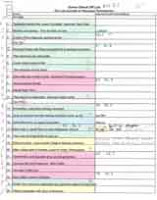
This is a great way for me to see my novel as a whole. Note the lovely colored lines. They have a greater purpose than mere decoration. I color code each scene by plot thread. In TATSOO, I had five plot threads moving throughout the book, thus the five different colors. Color coding like this is a terrific way to “see” the balance of your plot and subplots, you can easily determine if you’ve dropped a subplot or gone on too long without mentioning it. (The astute among you will note that there are only four colors. That's because I hadn't found a way to work the fifth plot thread into the first act yet.)
Next look at the scribbling in the right handed column, where I make notes. I can look and see when the last time a certain character appeared, or make a note of the first time some element is introduced so I don’t have the characters talk about it before then.
It’s also a great way to look at the plot arc, to make sure that scenes happen in the order that brings the biggest impact.
And lastly, it allows me to work on the novel in smaller, more manageable chunks.
Next up, how I use the spreadsheet to graph my novel.
Here’s the spreadsheet for Act 1 of Theodosia and the Staff of Osiris.

This is a great way for me to see my novel as a whole. Note the lovely colored lines. They have a greater purpose than mere decoration. I color code each scene by plot thread. In TATSOO, I had five plot threads moving throughout the book, thus the five different colors. Color coding like this is a terrific way to “see” the balance of your plot and subplots, you can easily determine if you’ve dropped a subplot or gone on too long without mentioning it. (The astute among you will note that there are only four colors. That's because I hadn't found a way to work the fifth plot thread into the first act yet.)
Next look at the scribbling in the right handed column, where I make notes. I can look and see when the last time a certain character appeared, or make a note of the first time some element is introduced so I don’t have the characters talk about it before then.
It’s also a great way to look at the plot arc, to make sure that scenes happen in the order that brings the biggest impact.
And lastly, it allows me to work on the novel in smaller, more manageable chunks.
Next up, how I use the spreadsheet to graph my novel.
Thursday, June 07, 2007
Left. Right. Left-Right-Left
When we were young, one of my brothers used to love to march. No matter how much he was balking at doing something or going somewhere, if you got him to march, he’d be okay. And of course, any of you fellow marchers out there recognize the call out for marching: Left. Right. Left-right-left.
Which oddly enough, described my writing process. (Oddly because I do not now, nor have I ever, had any interest in marching.) Only my left or right has to do with brain hemispheres rather than high-stepping.
Step One – Left Brain: Outlining and plotting.
When I outline, it is admittedly a rather messy process, but it is also organizational. I’m laying the foundations for structure, so it goes in the left brain category. In addition to exploring character and the story voice, I’m puzzling out the plot, what the conflict is, if it can sustain an entire book, what the turning points are, how the acts might break down. The thing is, I don’t force myself to adhere to this outline, and it almost always evolves during the course of the book as I get to understand my characters better. But it does give me some idea of where to go, of what to actually put on the page.
Step Two – Right Brain: The discovery draft.
This is pure, right-brained creative writing. Now that I have a basic sense of where I’m going, I just let ‘er rip. I try really hard to not censor anything and allow myself to go with whatever my subconscious tosses up at me. There’s tons of terrific stuff down there in our mental basement, along with an entire group of muses wanting to have their say. In Theodosia, much to my chagrin, I found I kept writing about her hat, and her not wearing one and getting in trouble for it. Enough already, I thought. But then at the end, I realized the hat was a lovely concrete object to stand in for her Father’s feelings toward her. If I had censored that out or tried to stifle it in any way, I would have missed out on a terrific ‘showing’ detail that kept me from having to ‘tell’.
Step Three – Left Brained: Structure
Once I’ve put aside the discovery draft to ferment, the structure loving half of my left brain comes out to play. And yes, even the left brain likes to play, even if it’s preferred method of play makes your palms break out in a sweat. I make lists of every scene in the book. On a spreadsheet. In one column I might note the source of conflict, to be sure there is one in that scene, and the next column might note what the plot goal of the scene is. If I have many subplots or plot threads, I’ll color code the scenes so I can be sure I’m keeping them balanced and not dropping any sub plot for too long a time. (Some people achieve these same goals with notecards or storyboards.) The thing I love about this method is that it allows me to see my entire novel at a glance, which is hugely helpful when looking at structure. And yes, I even—horrors!—graph my plots. (Just ask anyone who’s taken my online Revision class.) It allows me to check for rising action, to make sure the novel is getting more dramatic, more tense the closer to the end that I go.
Step Four – Right Brain: Deep Characterization work
This is where I go deep into all my characters heads. I usually have a pretty thorough idea of the main character, but in order to fully flesh out the novel, I have to know equally well all the characters. So I spend a few weeks journaling each of them to be sure I understand their motivations so I can make their actions and interactions believable. This is also where I look for all the breadcrumbs the Girls in the Basement might have left me. Things like the hat, that might lead me to something rich or thematic. You’d be surprised at how many clues your subconscious can leave you!
Step Five – Left Brain: Weaving and Polishing (Sounds like a day at a spa, doesn’t it? I wish!)
This is where I go in and weave everything from steps three and four into the manuscript and do a final editorial polish, cutting as much prose as I can. I am a huge overwriter (although, not on purpose) and Theodosia’s voice is especially prone to this, so I cut cut cut.
Such is my bizarre process. I realize it doesn’t work for everyone. Heck, it might not work for anyone but me, and that's fine. We writers are notorious for needing to march to our own drummer. (Ha! Get it? MARCH! I crack myself up some times.)
Which oddly enough, described my writing process. (Oddly because I do not now, nor have I ever, had any interest in marching.) Only my left or right has to do with brain hemispheres rather than high-stepping.
Step One – Left Brain: Outlining and plotting.
When I outline, it is admittedly a rather messy process, but it is also organizational. I’m laying the foundations for structure, so it goes in the left brain category. In addition to exploring character and the story voice, I’m puzzling out the plot, what the conflict is, if it can sustain an entire book, what the turning points are, how the acts might break down. The thing is, I don’t force myself to adhere to this outline, and it almost always evolves during the course of the book as I get to understand my characters better. But it does give me some idea of where to go, of what to actually put on the page.
Step Two – Right Brain: The discovery draft.
This is pure, right-brained creative writing. Now that I have a basic sense of where I’m going, I just let ‘er rip. I try really hard to not censor anything and allow myself to go with whatever my subconscious tosses up at me. There’s tons of terrific stuff down there in our mental basement, along with an entire group of muses wanting to have their say. In Theodosia, much to my chagrin, I found I kept writing about her hat, and her not wearing one and getting in trouble for it. Enough already, I thought. But then at the end, I realized the hat was a lovely concrete object to stand in for her Father’s feelings toward her. If I had censored that out or tried to stifle it in any way, I would have missed out on a terrific ‘showing’ detail that kept me from having to ‘tell’.
Step Three – Left Brained: Structure
Once I’ve put aside the discovery draft to ferment, the structure loving half of my left brain comes out to play. And yes, even the left brain likes to play, even if it’s preferred method of play makes your palms break out in a sweat. I make lists of every scene in the book. On a spreadsheet. In one column I might note the source of conflict, to be sure there is one in that scene, and the next column might note what the plot goal of the scene is. If I have many subplots or plot threads, I’ll color code the scenes so I can be sure I’m keeping them balanced and not dropping any sub plot for too long a time. (Some people achieve these same goals with notecards or storyboards.) The thing I love about this method is that it allows me to see my entire novel at a glance, which is hugely helpful when looking at structure. And yes, I even—horrors!—graph my plots. (Just ask anyone who’s taken my online Revision class.) It allows me to check for rising action, to make sure the novel is getting more dramatic, more tense the closer to the end that I go.
Step Four – Right Brain: Deep Characterization work
This is where I go deep into all my characters heads. I usually have a pretty thorough idea of the main character, but in order to fully flesh out the novel, I have to know equally well all the characters. So I spend a few weeks journaling each of them to be sure I understand their motivations so I can make their actions and interactions believable. This is also where I look for all the breadcrumbs the Girls in the Basement might have left me. Things like the hat, that might lead me to something rich or thematic. You’d be surprised at how many clues your subconscious can leave you!
Step Five – Left Brain: Weaving and Polishing (Sounds like a day at a spa, doesn’t it? I wish!)
This is where I go in and weave everything from steps three and four into the manuscript and do a final editorial polish, cutting as much prose as I can. I am a huge overwriter (although, not on purpose) and Theodosia’s voice is especially prone to this, so I cut cut cut.
Such is my bizarre process. I realize it doesn’t work for everyone. Heck, it might not work for anyone but me, and that's fine. We writers are notorious for needing to march to our own drummer. (Ha! Get it? MARCH! I crack myself up some times.)